
Permanent Exhibition
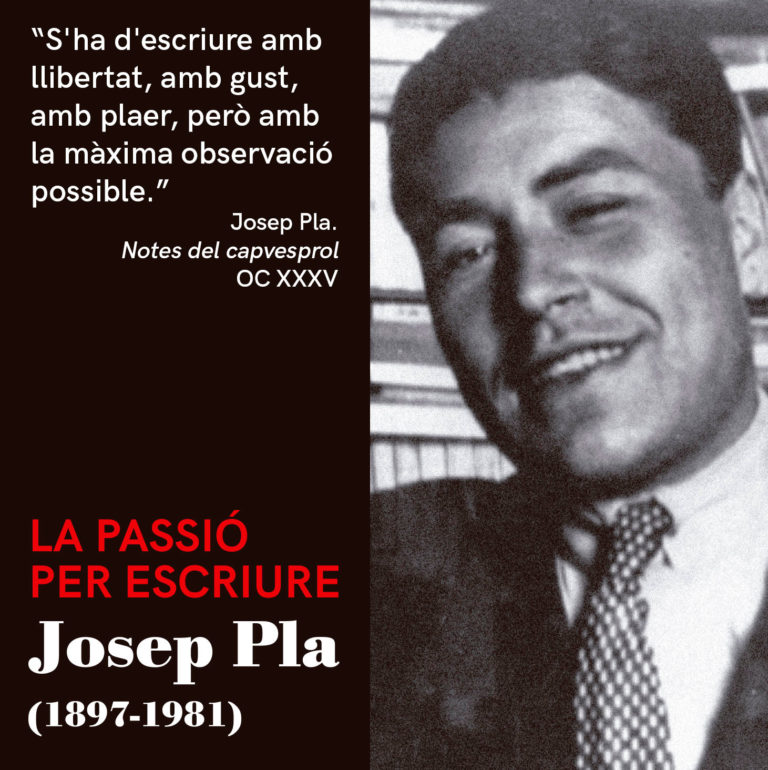
The passion for writing
Josep Pla (1897-1981)
“We should write with freedom, for the enjoyment of it, for pleasure, but with the greatest possible observation.”
Josep Pla. Notes del capvesprol. OC XXXV.
Josep Pla is the most important prose writer in contemporary Catalan literature. A writer and journalist, author of diaries, biographies, memoirs, novels and great reports, he travels all around the world while never forgetting his origins in Palafrugell and the Empordà, thus making the local become universal.
Pla possesses a veritable passion for writing and endows his work with a unique style: from a very personal and unmistakeable approach, he transforms his own life, experiences and readings into literary material, confusing it with true reality. In his texts, he constructs the image of a loner from Llofriu: a mask which enables him to hide the authentic personality of a sensitive man behind his literature, someone who is concerned about his family, who will have several romantic relationships and who is always surrounded by friends and acquaintances.
With this singular work within the Catalan literary scene, as a young man Pla is already garnering a great response and success with a wide range of audiences. Readers who even today still appreciate in his work a reflection on personal and collective identity, an extensive inquiry into the passing of time and memory, and a spirited portrait of twentieth-century Catalonia.
Grups prèvia concertació
Entrades individuals
Preu: 7,00 € i 5,00 € TR3SC i altres descomptes
Durada: una hora i quart, aproximadament
Reserva:
Consulteu l’agenda
Grups prèvia concertació
Preu per grup: 90,00 € (100 € cap de setmana i festius)
Els grups més grans de 15 persones s’hauran de dividir, per tal de circular amb més comoditat per l’exposició.
Durada: una hora i quart, aproximadament
Reserva:
info@fundaciojoseppla.cat – 972 30 55 77
Consulteu la nostra oferta al web d’Apropa Cultura:

1. Selfportrait
“A genuine self-portrait as promised to Sra. Lola S., never sent for dear I’d seem just too ludicrous. Height: five feet eight and a half inches [1.74 metres]. If we go by Retzius’s classification, my skull decidedly verges on the brachycephalic. I have a short head but a big one. I have thick, abundant hair. I wouldn’t have worried if I’d had none, but a barber on carrer de Cavallers prophesied to my mother when I was a child, I’m predestined never to lose my hair. I’ll have hair until the day I die, something that must have made my parents feel intensely proud and contented. It doesn’t amount to much, you might say, but it’s just as well to be happy with what one has. I don’t possess a huge, expansive, mercurial forehead, one that houses (hypothetically) a powerful intellect, that commonplace of novelists. I have a normal forehead that’s at a right angle in relation to the earth. My hair is neither blond nor jet-black. It’s somewhere in between. My nose was once a decent, elegantly arranged piece of cartilage. However, I myself destroyed the shape of my nose during [a slippery pole contest at] the annual fiestas in a village on the east coast where we went on summer vacation one year.”
Josep Pla. The grey notebook.
“Now, if I may, I’ll tell you about the important cities I’ve visited and lived in for long periods of my life. As I was young, time flew past, my wages were paltry and, having always been a complete anti-bohemian, I’ve accepted my life and what’s more, appreciated it! I’ve lived in Barcelona, Madrid, Lisbon, Porto, Paris, Bordeaux, Lyon, and Marseille; in Berlin, Hamburg, Frankfurt and Munich; in Genoa, Turin, Milan, Florence, Rome and Naples; in Stockholm, Oslo, Copenhagen and Helsinki; in Warsaw, Prague, Vienna, Budapest and Sofia; in Athens (Barcelona and Athens are the most populated cities in the Mediterranean); in Constantinople and Ankara; in Tel Aviv and Jerusalem; in Cairo and ports on the Red Sea, in Aden and Kuwait; in Moscow, Leningrad and Gorky; and many others that I can’t remember. I’ve had to sleep in so many beds! I’ve had to eat so many different foods, though it has to be said they were better than what is usually eaten these days, with only a few exceptions, in my country!»”
Josep Pla. Darrers escrits. OC XLIV.
2. Arround the world
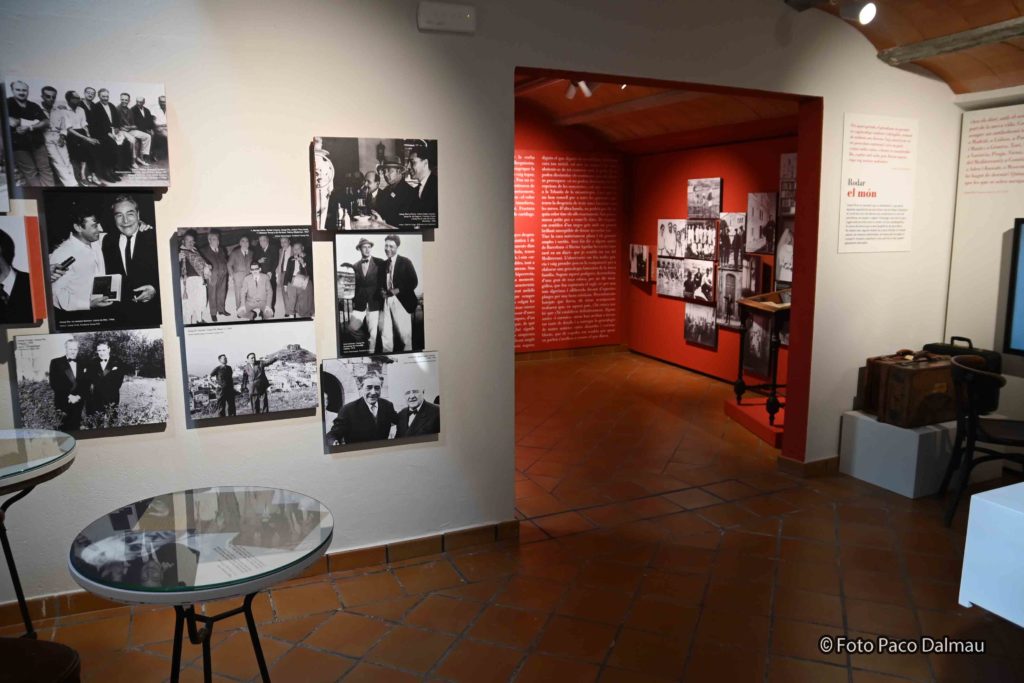
Foto Paco Dalmau
3. Things seen
“The writer has an overriding responsibility towards the era in which he is living.”
Josep Pla. La vida amarga. OC VI.
“Everything in the Mediterranean is local: the weather, cuisine, dialects and people. Everything here is constantly changing. A few miles to the south or to the north and everything varies: the direction of winds, the taste of the fish, the amount of garlic in a stew, languages, tastes and feelings. These shades can be astonishing.»”
Josep Pla. Aigua de mar. OC II.
4.The struggle against oblivion
“Homenot, en català, no té cap sentit inconvenient i despectiu ni cap matís necessàriament grotesc: més aviat s’aplica a persones singulars, de personalitat grossa, voluminosa, rellevant, humanament densa. És possible que a l’època dels nenúfars lilials i de les carnacions morades i evanescents la paraula fos considerada grollera. Avui, que la burgesia ha esdevingut tan combativa i es deixa amb tanta eficàcia dirigir, és gairebé segur que el matís liberal-decadent de la paraula ha caigut completament i s’ha esvaït. «Homenots» vol dir avui el que en la nostra llengua volgué dir sempre.”
Josep Pla. Homenots (segona sèrie). Selecta, 1958
5.The enthusiasm for writing
“I have to confess that I wouldn’t have known how to do anything other than write.”
Josep Pla. Per passar l'estona OCXXXVI
“Literary subject: Sketch the flight of a bird in a line and a half.”
Josep Pla. El quadern gris OC I
6.The undulating life
“
I wouldn’t do anything that would draw the attention of the press. I appreciate the piece you have produced, but it won’t sell a single copy. The book will sell slowly, but it’ll sell. I’ve been writing for so many years, I’ve written so much nonsense, so many people know me and, above all, the book is so wonderfully printed, that they will want to have a copy and will buy it.
I have at least two thousand solid, reliable, admirers who will promote the book. Maybe a greater number, maybe fewer. These people will promote, and are promoting my work. I vouch for nothing else. These are people who’ve been following me for fifty years. I don’t know who they are. They like everything I’ve written; simply because they like it, for the enjoyment of it, for the desire to pass the time. It’s something that constantly surprises me, but it’s also real.”
Letter from Josep Pla to Josep Vergés, August 1966,
a few weeks after the publication of El quadern gris.
“The house is admirably placed on the landscape. The men who built it were part of the most glorious anonymity. However, they were aware of the weight, the shapes, the spirit of the surrounding reality. An instinctive good taste, born of his innate humility, eliminated from his view of things all presumptuous broadside, any whim of singularization.”
Josep Pla. Els pagesos OC VIII
7. El mas Pla